
Cordilon Gaming is a blog, a YouTube channel, and a Twitch channel. Our goal is to deliver reviews that are honest and informative and visual content that doesn’t suck. We love the kinds of games that aren’t covered often by big sources, including indie games, mods, games from eras gone by, and sometimes even higher-budget games that aren’t often seen in the media (or may be, depending on what we’ve been playing a lot of recently.) Here at Cordilon Gaming we have respect for all sorts of games, especially those that may not be attractive to those who are used to the mainstream, AAA blockbusters that dominate today’s video game market.
-
Stream Thoughts: Final Fantasy IV

This is part stream thoughts, part review, and part an exercise in getting back into writing again.
We took this weekend off from streaming for two reasons. Foremost, I lost my voice somewhat to a cold and didn’t want to subject the audience to four hours of wheezing and groaning. But secondly, I said I was going to do a post-mortem for our most recently completed stream longplay, Project II: Final Fantasy IV. So in lieu of a stream this weekend, have an article.
Usually when there’s a turn-based RPG that we want to do on stream, I’m not the one playing it. This isn’t particularly because I’m bad at them, but because I haven’t played as many and my repeated failures are less likely to bring more people into the viewing audience. No one wants to watch some idiot bumble around a video game unless they’ve already committed themselves to watching that idiot. And from this idiot to you, thank you for suffering through my terribleness. Your grace knows no bounds.
To relieve my dear compatriot and reality-grounder of her usual duties on our Saturday streams and give her the opportunity to laugh at me, we decided that I should do an RPG on stream, one that she was familiar with. We settled on Final Fantasy IV, but with a twist: The version we would use would be the mod/romhack called Project II. This hack is a new translation of FFIV, remedying the myriad issues with the various translations that have been released over the years. It also restores a significant amount of dummied content and fixes various bugs and outright useless pieces of equipment and spells, but we’ll get to that in more detail later.
Morgan has played Final Fantasy IV several times through, making her an excellent guide through the game to make the process smoother. While by no means am I new to the concept of turn based RPGs, I haven’t played many of the Final Fantasy series to be quite honest, and having someone who knows the game fairly well handy and watching my every move did have the wonderful effect of bringing my peak stress levels down from “holiday season retail manager” to “holiday season retail temp hire”. It’s a potentially aggravating experience, and it’s something new with foreign oddities and incomprehensible processes around every corner, but at least it’ll be over soon.
Fallen paladins are cliché; let’s make this one un-fallen
Needless to say, beyond this point, hic sunt spoileres.
In contrast to its direct successor or its predecessors, Final Fantasy IV gives you more party members than first gen Pokemon over the course of the story, but never more than five at a time. The one constant is Cecil Harvey, who begins the story as a dark knight of the kingdom of Baron and the flight admiral of the Red Wings, Baron’s air force. His defining features: a suit of black armour fused to his body and scouter-breaking power levels in self-loathing. Not long into the game he has a magical transformation through the powers of self-realization and self-harm — seriously, you get to 1v1 yourself — into a Paladin, making him possibly one of the first examples of a “fallen paladin” type that becomes un-fallen.
Unfortunately, Cecil’s functionality as a DPS-focused paladin class is more like that from modern World of Warcraft and less Dungeons and Dragons. While his white magic can certainly keep himself topped up between fights early into his paladinhood, he never learns anything more powerful than Cura, doesn’t pick up Revive, and has an unfortunate late-game lack of willpower stat to make up for either of those. Thankfully, Rosa is not only a competent healer but well into end-game her single-target Curaga tends to be enough to put a near-death character back up to full health for half the MP cost of an actual full heal in the form of a Curaja. Her !Aim ability to throw out extra projectile damage with a bow equipped also makes her a useful healer with DPS on the side during low-damage fights of attrition.
A good RPG has a good plot, and Final Fantasy IV fits that requirement. The usual bad-guy-is-doing-bat-things-with-the-crystals kicks off the story, but the game throws you for a loop after the first four crystals fall with “by the way there’s another set of crystals in Hell, which is populated by Dwarves, and has the literal Tower of Babel, and also magma-resistant airships”. And it just gets more and more nuts from there, but entirely in a well-written, planned out way that all ties together neatly at the end. My one complaint is that the plot had the core party member Kain flipping between heel and face so often that it felt like he was switching sides every five minutes. This is something that’s repeatedly cited on the intertubes, I came to find out, though in actual fact he only does a complete moral 360 twice in the course of the game. What makes it feel like a more frequent occurrence is the effect this has on your party; you lose one of your main sources of reliable, heavy-hitting physical damage and get to replace him with another character for the next two or three hours.
There’s an awful lot of other characters who you rotate in and out throughout the game, but generally you’ll end up with a caster, a second melee DPS, and someone else. For endgame, though, your three other party members are a Dragoon (the aforementioned Kain, better known as The Dragoon), a Summoner (Rydia, post-time travel), and a Ninja (Edge, who is so non-notable I had to look up his name). Kain spends most of his time in the air using !Jump so he only gets hit about 50% of the time, if even that, making him an incredibly useful party member when he isn’t busy getting mind controlled int doing evil shit. He gets exactly no magic, though, so his utility is limited. The best that you’re going to get out of him that isn’t damage is him missing a fully party wipe attack while he’s in the air and then chucking out a Revive Potion at Rosa as soon as his turn is up.
Rydia is my favourite character on account of her getting literally all of the nukes. She starts the game as a young girl whose god you slay and whose mother you murder, leaving her severely traumatized and in your care. Congratulations, you’re the best protagonist ever. You asshole. Thankfully after being sucked into the ocean by Leviathan, she spends a solid decade in the Feymarch and reunites with the party as a grown woman with her traumas mostly behind her and most of the main recurring Final Fantasy summons to deal with everything else. Her damage output gets frankly absurd after your return to the Feymarch, since Leviathan as a summon throws out massive all-target non-elemental damage, and later, Bahamut more or less replaces Leviathan in your rotation. Presumably, while waiting in the astral plane and watching the battle, Bahamut responded to Leviathan’s smarmy “did you see THOSE damage numbers” with a casual “hold my beer while I dish out quad nines”.
Edge soaks damage, throws smoke bombs to make running away cheaper (standard L+R running has a chance to drop a percentage of your gil), and can cast Blink on himself with the Mirage ninjitsu. Sometimes he’ll get revived before the end of the battle. Sorry buddy, that’s all I can really think of to write about you.
ATB is my greatest enemy
Final Fantasy IV birthed unto the world the Active Time Battle System, or ATB. The gist of ATB is that instead of having a fixed initiative order that each entity on a battlefield takes its turn according to, a la most pen-and-paper roleplaying games, the initiative order is used at the start of the battle, and then turn order is based on whose ATB gauge recovers first. When a character uses an ability or attack, their ATB gauge is depleted, and it refills according to their speed and speed-related stats. This is a gross simplification of it, but at least for FFIV, it’s close enough. On paper this concept is incredibly simple but in practice, for those of us who have the reflexes of a stoned sloth, this can get to be a bit of a pain point.
It took me about a session and a half to get back into the swing of things with ATB. For that six or seven hours though I was an immeasurable idiot getting hit more than I needed to while I decided what to do. This is something I tend to have issues with in RPGs, preferring a slow and methodical (read: overthought and paranoid) approach. The trick, as I eventually came to use, is to open a magic or targeting menu in a battle to pause the ATB system. Then I can safely relax and spent fifteen seconds freaking out and plotting every possible thing that can go wrong in the next three to six turns. Invariably, I would do this several times in the timespan of a single turn, only for Cecil to throw out five times as much damage in a single blow as I was expecting. The moral of the story? Get therapy.
Being the first implementation of the ATB system, FFIV‘s battles are a bit difficult to feel the pacing of sometimes. The ATB gauge is not visible, unlike later games, so predicting turns and planning ahead has to be done with a healthy dose of guesswork. The final battle ended up being a bit of a stress point for my run when party members started going down and I had no visual indicator for when one of the living party members would have their next turn to throw out a Revive. In the early and middle acts of the game, the guesswork gets more difficult because of how many characters join and leave the party every other town. Imagine if Goku was the only saiyan who could safely spend an entire episode powering up because none of the other characters were guaranteed to be around for 22 sequential minutes.
The gameplay is on the whole quite fun. This is the only main series entry where you get to keep five “permanent” party members at a time, so in case things start going really badly you have an extra chance at a turn for throwing a Revive at someone or soaking an attack. Cecil is a phenomenal damage dealer and an equally phenomenal tank when he has Blink cast on him. He will attempt to block damage meant for party members who are at critical health levels, and having Blink on him makes him when there’s a near-downed ally makes him a damage-nullifying machine.
My main criticism of the game from a mechanical standpoint is that they hadn’t quite figured out how the SNES worked while developing it, so the main way of communicating “something magical is happening on screen” is to change the colour palette and flash the screen wildly. This incredibly NES-tastic part of the game shows up every few minutes, so if you’re prone to photosensitive medical distress, grab one of the ports of this game so you don’t literally die from playing what is otherwise a solid turn-based fantasy RPG.
A romhack and then some
Project II is a bit different than vanilla SNES Final Fantasy IV. As mentioned before, the translation is completely re-done, as the original translation released to North American audiences as Final Fantasy II ispoorly written and fairly deeply censored and in the words of vivify93, the mod’s author, “J2e’s translation of this game is rife with awkward hacking, strange phrasing, and over-the-top references”. Project II contains a whole new translation based on the original release of Final Fantasy IV with a pile of enhancements, including dummied-out enemies and abilities being implemented, commands like Pray and Salve working as intended, in-battle effects for various spells that didn’t have in-battle effects originally, and my personal favourite, so many minute balance tweaks to everything that it comes with a stack of reference manuals.
Morgan and I both thoroughly enjoyed Project II, as it gives a bit more of a modern, updated feel to a game that is 27 years old at the time of writing. It’s still not too modern — the traditional English names of spells are used, and you’re still well aware that you’re playing a game that’s old enough to get a PhD and complete residency, but at least it’s not one of the horrible mobile ports. You can download Project II from ROMHacking.net here: https://www.romhacking.net/hacks/1659/
I’m not sure if this is a function of Project II or if Rydia is this awesome (one might say, best girl) in the original game, but the final battle was primarily everyone except Rydia eating hits or attempting to dodge them, and Rydia dishing out quad nines and ignoring damage entirely. Not only was she the last party member up, but I was convinced we were going to wipe when Zeromus began to cast Meteor. Rydia decided she wasn’t going to have any of that shit and the spell didn’t even go off. Her subsequent Bahamut summon, on the other hand, did complete, and it turns out that Bahamut really doesn’t like transforming moon people.
Lessons learned
There’s a few things I’ve learned from this, some by force, others out of my own free will.
- Listen to Morgan when she attempts to explain mechanics. This saves me a lot of pain.
- As much as the game was attempting to induce it, I do not have photosensitive epilepsy.
- Download your VODs immediately after they process so you can archive them ASAP.
- Plan the next game we play well in advance and test the hell out of your emulators.
- Rydia does mechanics, and that makes her best girl.
Next Saturday we’ll be starting up Final Fantasy III on NES. Morgan will be playing since I plan on actually sitting down and doing some stuff mid-week, and after FFIII our plan is for me to play a game that neither of us have played but both of us have heard good things about: Phantasy Star IV on the Sega Genesis.
-
Stream Thoughts: Super Mario RPG
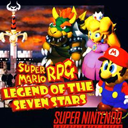
Well this is a bit late, isn’t it?
Probably because we finished Super Mario RPG and I enjoyed it, so I didn’t feel the need to rant immediately. [editor’s note: also because Troy was very slow at getting the GIFs for this post done.] SMRPG got a lot right and very little wrong, and I’m really looking forward to Paper Mario: The Thousand-Year Door. We’re skipping Paper Mario because while it’s a competent game, of the three console Mario RPGs that actually count, it’s the weakest. Writing’s fine, but the gameplay is a bit too simple.
Right out of the gate, Super Mario RPG gets you started. No lengthy cutscene, no slow exposition dump. You’re Mario, Bowser just took the Princess, and you’re invading his castle to get her back. This doesn’t work, because if it did the game would be over entirely too quick. A giant sword crashes through the castle and sends everyone flying. Mario lands in his own house, on a clothes peg, and Toad immediately snarks at him for it. Then he suggests that you go back to the castle and get the Princess. You do, and you don’t, respectively. The sword collapses the bridge by violently flapping his gums, and you go back home to explain to Toad.
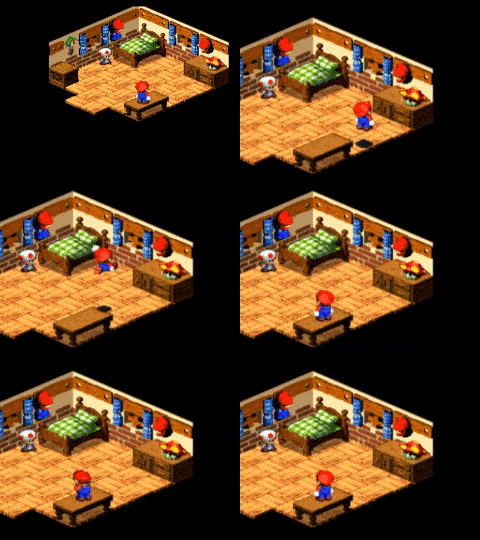
The game subscribes to the Chuck Jones theory of gravity. The explanation is the best way I’ve ever seen a silent protagonist handled, and I wish all future depictions of Mario handled dialogue the same way.
That’s really where the game shines. The humor is on point for basically the entire game. The returning cast are joined by new characters Mallow and Geno, who both manage to fit reasonably well – Geno feels a bit more out there than the rest of the cast, but given what he is it works. Further in, Bowser joins the party, and he’s another great example of characterization I wish had stuck more (though some of it does seem to have been kept. Sometimes.) He’s a badass and he knows it, but he also actively tries to maintain his reputation and repeatedly shows that he cares about his minions – even the ones that have retired. It’s unfortunate that in practice he’s one of the weaker characters.
So let’s talk about that. Game balance. Your party consists of five people, three of whom can be active. One thing that’s appreciated that wasn’t always standard is that your entire party gets full experience, whether active or not. That’s great. So, five people – Mario, Mallow, Geno, Bowser, Toadstool, in order of joining. Mario is well-rounded and effective, and can’t leave the party anyway. Luckily, you’re stuck with a good character, almost certainly third-best. Mallow works great in the early game with a decent healing spell and solid elemental offense, but if that sounds like a Red Mage, you know where this line’s going – he falls off pretty hard later on unless you’re really good at timing Star Rain. I am not.
Geno’s amazing, the best offensive spellcaster and a great physical attacker too, with the highest base speed and a solid HP pool. Not much for straight defense, but he can eat magic attacks adequately. Bowser’s a tank with great physical power when you get him, but his problem is that he falls off later in the game when enemies start throwing powerful magic attacks. You can still make him work in Geno’s place, but you’ll have to really be focused on keeping him alive. He has some status spells, and some plain damage ones – do yourself a favor, stick with the status. Terrorize, specifically; Fear is a massive offense and defense debuff that works pretty often. Toadstool is amazing all the way through – a cheap full-party heal that’s likely to be effectively a full heal and a guaranteed status cleanse, a 2 FP revive that, if you get the timing (easy to do), is a full revive, and if you get her best weapon she has an adequate offense too.
Yeah, the balance kinda fell apart at the end there, didn’t it? Your best three are almost certain to be Toadstool, Geno, and Mario, and likely in that order, but the game’s easy enough you can use whoever you want. That being said, it should also be noted that it doesn’t matter who you use, for plot events your entire five-man crew is present. Again, this is appreciated, though I can completely understand why this wasn’t usually the case in Final Fantasy VI.
Now, this being an SNES game with a lot of text, you may have some concerns about the localization. It’s mostly very good, with the exception of the spells Drain, Mega Drain, and Drain Beam. None of these in any way absorb health (which is good, because that last one’s full-party) and I have no idea what’s up with the names – Drain’s just a small fireball. I don’t remember anything in dialogue striking me as being particularly off like in Lufia 2 or the RPGe translation of Final Fantasy V. Every character pretty clearly had their own voice, they were consistent, and it usually flowed well.
Also, the bonus bosses. Culex hits like a train loaded with trucks, and Jinx is just an asshole. The good news is that timed defense works on instant death attacks. The bad news is Jinx uses them a lot and unless your timing is frame-perfect you have 1 HP afterwards. Still, fun fights with constant pressure, especially Jinx. Culex did devolve a bit into being an HP sponge once the Crystals are down. And even though I’d beaten both, Smithy’s offense was still impressive – though I was still pretty well short of the level cap. This was likely helped by him having several exclusive spells.
This is my third or fourth time through SMRPG, and I can still easily see myself playing again – though this one was more fun than the last because of the bonus of being the first time Troy saw most of it. It’s not a hard game, but it is undeniably fun throughout.
-
Fourteen Ninety-Nine: In retrospect, we put up with a lot of crap

On this very special episode of Fourteen Ninety-Nine, Troy has a flashback to being chain-stunned in battlegrounds by a rogue with RNGsus on his side, while watching the BlizzCon annoucement for Classic servers…
For the first six months of its life, World of Warcraft was a complete shitshow. The game was, by almost all accounts, unfinished and rushed out the door, likely to beat some EverQuest hype train that was about to depart the station. The level 50-60 range was practically devoid of quests, and the mid-game was rather lacking in dungeon content to offset the grind. At one point, the French and German versions of the had a broken loot rolling system that just wouldn’t work. There was no group finder, no matchmaking, and no organized PvP system.
And yet, this was more polished and more fun than most of the MMOs that were out at the time. So much so that people remember it as if vanilla World of Warcraft was the result of the heavens opening up and the hand of Yahweh descending to deliver it unto the chosen peoples of the land (apparently, the intersect of disgruntled Everquest players and Frozen Throne fans), and those same people begged Blizzard to launch official vanilla throwback servers so hard that this year at BlizzCon they said they were going to do it. This is an insanely nutty idea that I am immensely looking forward to and today on Fourteen Ninety-Nine, we’re going to take a look at some of the more egregious violations of sanity that early World of Warcraft had with the kind of nostalgia that only exists elsewhere in vaporwave and arguments about the Berenstain Bears.
Note: I am not slandering Blizzard here. This is all about how massively things have improved in quality since the mid-2000s for MMOs. I would be all down to do vanilla WoW’s progression with some of the major QoL improvements recent expansions have functionally added. Hindsight is better than 20/20 in this case.
I apologize for the relative lack of interesting pictures in this article. I don’t have any screenshots from twelve years ago and getting new ones is complicated by Blizzard C&Ding all the 1.12 private servers.
What do you mean, nobody has the key? Fuck it. *disband*
Once upon a time, raid progression was a real hardcore progression system, even just to enter a raid. At launch, Blackrock Spire was split into Lower and Upper Blackrock Spire (LBRS and UBRS), a pair of incredibly long dungeons. Entering UBRS was done by actually entering LBRS, as they were the same actual instance. Except UBRS was literally gated behind a door you could only enter if one of your party members had the Seal of Ascension, a ring created by combining four rare drops from LBRS, none of which were guaranteed to drop in a single run. In order to definitively unlock UBRS for any raid party you formed, you would have to have run LBRS enough times that not only were the drops needed to craft the Seal of Ascension actually dropped, but you yourself would need to be the lucky person to roll higher than everyone else who wanted to craft the goddamn thing. And then your paladin would fuck up in the Rookery and your team would wipe.
After Blackrock Spire there were two 40-man raids available from the outset: Onyxia’s Lair and Molten Core. Anyone who remembers these fondly either had an incredibly good raiding guild or is lying through their teeth.
Onyxia’s Lair had a similar requirement to UBRS in order to gain access to the raid, except instead of one person needing the item, everyone needed it, and the process to get it was a world-spanning quest chain (14 quests for Horde, 16 for Alliance, both of which required farming trash mob drops in both Blackrock Depths (the 5-man dungeon precursor to Blackrock Spire) and UBRS. Also, parts of the quest chain were started by random drops from mobs in UBRS after you had completed the previous quests in the chain. Weeks of praying to RNGsus later you would finally end up with everything you needed to do Onyxia’s Lair. Your 40-man raid party would enter the instance and be greeted with… one tunnel and a boss room. And whelps. The difficulty and challenges of a smooth completion of Onyxia was shown to the world in 2006 when a recording of a raiding group’s Ventrilo surfaced and was immortalized with a Flash animation (oh man remember those) called Onyxia Wipe. If you have ever heard someone saying “many whelps, handle it”, “that’s a 50 DKP minus”, or “WHO THE FUCK WAS THAT”, this is the source, and it continues to be one of the funniest things I’ve ever seen on the internet.
Aside: I’m not going to try to fully explain the Dragon Kill Points (DKP) system, but for the purpose of further hammering in how much of a mess vanilla was, it was a currency in EverQuest that raid groups gained by guild kills of dragons, and was used to weight guild members’ influence on the overall dragon kill count of a guild for the purpose of distributing loot. EverQuest raiders who ended up in World of Warcraft were dismayed by the lack of such a power trip enabling system and invented their own DKP system that had no in-game representation. Eventually DKP addons for WoW were created, but with the relatively recent advent of personal loot and the multitude of academic papers written about how shit the DKP system was*, no one uses it anymore.
Molten Core was the other 40-man raid, and it was the big one. If Blackrock Spire was a slog, Molten Core was a marathon. More interesting, much more difficult, and longer, the raid was opened when World of Warcraft launched and the world first completion was 154 days later. Most completions took between 4 and 6 hours, and a lot of the early attempts barely made it halfway through the instance in the seven days alloted per group before the raid reset. This is actually more of a case of the awesome of early World of Warcraft, mind you. Blizzard made something so difficult it wasn’t completed for two whole content patches, and even into the later stages of vanilla World of Warcraft, clearing Molten Core was a triumph.
The only problem was getting there. Remember when I mentioned Blackrock Depths? Molten Core’s entrance was at the end of that dungeon. If you didn’t have the attunement, each 5-man section of your 40-man party would have to run through Blackrock Depths in its entirety to reach the entrance to Molten Core and meet up on the other side of the raid portal. But if you took a quest outside of Blackrock Depths that told you to go to Molten Core and pick up a little item from the entrance and bring it back to the quest giver, you could enter Molten Core by just asking the him in future runs to teleport you right to the entrance.
Blackwing Lair had a simplified attunement quest, similar to Molten Core’s, acquired by killing an orcish quartermaster near the entrance to Blackrock Spire and reading the letter from his boss he drops (which includes the line “P.S. Destroy this letter, idiot.”, no shit). You then have the fortune of needing to run through Upper Blackrock Spire (ahaha you thought you were done with that dungeon you poor fuck), kill the final boss, and use the glowing orb behind his corpse. You can now teleport to Blackwing Lair from the entrance to Blackrock Spire instead of having to run through all of UBRS each time.
Seven years later, Blizzard remembered how much they liked milking the everloving shit out of Blackrock Mountain for dungeons and added two more.
Free stuns and chain procs and instas, oh my
PvP was hilarious. Battlegrounds for organized PvP showed up not long into WoW’s life, because other than that your only option for PvP was to turn your flag on (or live on a PvP server) and wander around in the wilderness hoping that you found someone else with their PvP flag on before they found you. People then realized your chances of winning a fight improved if you roamed in groups, and eventually you’d have wars breaking out in high level zones at random and roving squads of decked out players ganking you for having the audacity of being alone. Or you could be looking for a fight in a zone with no one in it for hours.
One of the best classes for PvP both solo and in groups has always been the Rogue. They have plenty of stuns, DoTs, and interrupts, and played effectively, can tear down a team’s back line (the squishies – priests and mages notably) in seconds. This does come at the price of only having leather armour and a fairly low stamina pool, but who cares, the other team’s support is dead and yours isn’t.
PvP had a notable feature in vanilla WoW: specialization talents. These were technically useful for PvE as well, but some of them truly shined in PvP. Rogues could equip one-handed maces, and with the Mace Specialization talent available in the Combat tree, they had a chance to stun a target with any attack made with a mace. Arms Warriors with the Sword Specialization talent gained a chance to deal a free extra attack with any attack made with a sword.
Now, two things applied here. These were procs made possible on any attack made with these weapons, including special attacks, finishers, and abilities that calculated based on weapon damage. Meaning you could use a finishing move on an opponent, get the proc, and be damn sure they were dead. Additionally, the attack from the proc counted as an attack for the purposes of the proc chance, and with some luck, the free attack could gain another free attack.
You can see where this is going.
Sword Specialization could also crit, and it could proc off of special procs on your weapon and vice versa. It was entirely possible to see a Warrior open up with Mortal Strike, get a sword spec proc crit, proc a weapon’s special trait, and then get another sword spec proc off of that. Considering warriors with two-handed swords already did more or less enough damage to take off a quarter of someone’s health bar with a single Mortal Strike, this chain would result in a very dead opponent in a single button press. Warriors with pocket healers could take on entire parties at a time.
This might be coming back in a sense in the next expansion, Battle for Azeroth. There’s a massive stat squish incoming and in one demo, someone at WoWhead noticed that the Warlock heavy-hitter spell Chaos Bolt was doing about 40% damage to a character’s health pool in a single 3-second cast time. Get fukken in.
Uphill both ways in the raid AND WE LIKED IT
For a while, before Meeting Stones existed, at least one warlock and two other raid members had to get to the instance entrance ahead of everyone else and start summoning. Ritual of Summoning, gained at level 20, did the same thing it does now, except back in the day it was the only way to quickly get your entire raid to the instance entrance. Nowadays you can just queue up an instance through the content finder while you’re all futzing around in Stormwind or whatever. When they added Meeting Stones, they were used for finding extra players to fill in slots in a party, and not actually for summoning the rest of your party if you didn’t have a Warlock handy. Meeting Stones weren’t supplements for Warlocks until Burning Crusade, by which point everyone had stopped playing Warlocks as their raid rotation was effectively “hit Corruption once, then spam Shadow Bolt for 10 minutes”.
But realistically, this wasn’t a problem. There was almost as much a feeling of accomplishment of getting all 40 players to the instance successfully and prepared to enter (including having all the mages sit around and conjure food and water, a couple units at a time, distribute it, and then tossing Arcane Intellect on everyone over the course of five minutes) as there was actually getting through the raid with a minimum of wipes.
But god damn, was it ever satisfying. I wouldn’t say the current system of flex raids and LFR has diminished the value of getting through a raid. In a lot of ways, it’s improved the experience significantly. But there was always a specific feeling of community and togetherness involved in the old raids in pre-raid-matchmaking World of Warcraft. 40 players, working together, delegating subcommand, planning strategies, preparing for the encounter, and then executing them as precisely as possible, and coming out on top, was as much a social accomplishment as it was a technical one.
Sure, farming Maraudon for nature resist gear sucked. Hunters having a dead zone between 5 and 8 metres away from them where they simply couldn’t attack (too far away for melee, too close for ranged) was gnarly enough that they eventually removed it in Burning Crusade. And the whole specialization of Fire Mage being effectively useless in a lot of the endgame content (five instances in Blackrock Mountain? Don’t mind if I do!) was as pants-on-head as the feral kid who wasn’t ever really expected to pass any of his classes and was basically just dumped into the system so his mother could sit at home and drink boxed wine and cry all day.† But it’s not only what we did and enjoyed, but was more fun than a lot of the other MMOs at the time. At least we didn’t have to put up some inter-guild dialogue to determine who got which world spawns which days of the week because there was no instancing system (sorry, EverQuest.)
Given the choice of modern theme park WoW that’s flexible enough you can get through it with as few as ten people or as many as thirty, versus old-school one-step-above-sandbox WoW with 40 man as the one true endgame size, I’ll take the modern one. But if I could have both, I would.
As long as I don’t have to pay a second subscription.
Don’t do this to me, Blizzard.
Footnotes
* Maybe when your meritocratic loot distribution system is described and cited as a point of frequent social devastation in a thesis entitled “Addiction and the Structural Characteristics of Massively Multiplayer Online Games”, you need to step back and think it over. Or maybe I’m just used to raiding with people who aren’t assholes.
† Other things that sucked horribly include targets having a maximum of 8 debuffs on them at once, and any new debuff applied would shove the oldest debuff off into oblivion, the majority of Paladins not knowing they could complete a short class quest to gain the ability to rez people, raid trash being a cycle of pull, drink, pull, drink, pull, eat and drink, repeat, Blessing of Protection only lasting five minutes and being a single-target buff, Retribution being at the bottom of the DPS charts… thinking about it, Paladins pretty much got shafted for raiding in vanilla.
-
Stream Thoughts: Seiken Densetsu 3: Sin of Mana
We’ve been streaming for RPG Saturdays for a while now, but Sin of Mana was the first modded game we used. Perhaps I chose poorly.
It began with me, as Hawk, getting killed several times in one shot by an enemy on the way out of the starting area. The solution was to leave and return until one I could survive spawned. But in the course of these deaths, the death HP penalty kicked in. Oh, yes, this mod has a death penalty. 10% of your max HP. Your punishment for dying is that dying is easier. There’s a reason Final Fantasy XIV’s battle-res penalty dropped the Vitality reduction in favor of stronger offense penalties – if someone’s already dying, the last thing anyone needs is for them to die faster. Death spirals are not fun. This penalty is most punishing in the early game; revival with Angel Grails spares you the penalty, but those are expensive.
About an hour of frustration into it, we applied one of the lower difficulty patches, the Normal one (mid-range, 3 out of 5 with default being 5 and 2 being compared to the original, though I’m starting to have doubts given that praetarius5018 thinks the default is reasonable). At this point, the game was fun again. There was occasional grinding necessary, but figuring out what worked against the bosses was interesting and an improvement over the unremarkable slugfests I vaguely remember from my attempt at the original. On the other hand, Lugar was a straight-up brawl, but it was paced well enough to be fun – just two sides beating the hell out of each other at a steady pace. Healing wasn’t stressful but it also wasn’t too easy and the fight didn’t overstay its welcome. The God-Beasts is where the fights started to get unpleasant again, mostly for sheer length.
The Eight Gimmick-Beasts of Mana
Dangaard, God-Beast of Wind, was fought first. Dangaard wasn’t bad, actually, despite having four phases. There were some differences in each one, and the phase transitions helped make the fight feel like it was actually moving along. Solid battle, that. No complaints.
Xan Bie was number 2. Xan Bie took entirely too goddamn long. His main gimmick is that the furnace thing heals him for 999 periodically. It took some time for it to register to me that there were two targets at all, which is probably at least partially on me, but I feel like it could’ve been a bit more apparent – especially since the little infobox that shows spell names and whatnot pops up over top of the thing. The gimmick’s execution made sense, but the fight took ages even after figuring it out. The furnace just had too goddamn much health for my tastes. Xan Bie’s other gimmick is that his attacks reduce your max health, to a minimum of 100. This is temporary, cured by death/revival or the end of battle, and it made things… interesting. In particular, our healer – Paladin Duran – was actually able to keep up pretty easily because health numbers were so low.
Fiegmund was 3, and I would just like to say his weakness made no sense. The water god-beast, with distinctly fishy fins, in the Labyrinth of Ice Walls, should be weak to fire or wind (lightning), right? Nope! Dark, as far as our testing could determine. Immune to fire. I’m not sure what’s up with that. His gimmick was jumping around to unreachable positions and using damage-over-time effects. You could hit him with spells or techs. Solid gimmick, and by this point every team should have some decent spell output, especially since Sin of Mana gives you MP regen. No objections, would make godbeast sashimi again.
Mispolm. Mispolm is absolutely abhorrent. There are some very interesting things about him – he seems to be weak to techs, taking 999 from Duran’s and Hawk’s (and I’d been building Rogue Hawk as essentially a mage). Near-immune to all the magic we threw at him (including stat loss), but taking plenty of physical damage. He has two gimmicks, though. The first one is status effects. Sleep, silence, poison, petrify, moogle, chibikko – basically, all of them except Snowman. Full-party, in many cases (more on that in a bit). The second is a Thorns effect. Fans of Diablo 2 are familiar with the notion – you hit, you take damage. Oh, but Mispolm gets creative about it. Because it’s not always that.
Sometimes you just get petrified.
I now, in hindsight, suspect that his casting of Stone Cloud on himself was intended as the tell for the petrify counter, but it’s not something we could make any sense of as it was happening. Probably in part because that was our first time seeing the spell, and even then I knew that wasn’t the normal effect.
Incapacitation, Interface Screws, and Spontaneous Screw-Yous
Now, returning to the bit about status in general, we were doing two-player. In Seiken Densetsu 3, if the character you’re controlling is incapacitated – dead, petrified, asleep – you get forced off to another character. In single-player, this isn’t a big deal. In two-player, if everyone, or all but one, are incapacitated, player 2 just gets dropped entirely and has to rejoin. This seems minor, but in the middle of a boss fight can be quite jarring – especially with Mispolm since who gets which character is almost random with how many status effects are getting thrown around.
Only through digging through the documentation have I found a setup that resists all of this crap. With a very specific set of armor, helmet, and accessories, you can in fact be resistant to all status effects. The problem with that is that this leaves you with limited defenses, and between the thorns and one head munching on Duran for over 300 damage, that’s kind of an issue.
Equipment shuffling is kind of a central part of Sin of Mana, and to an extent I like the concept of preparing for a given fight. The problem is that there’s an inherent trial-and-error aspect to that, since the included documentation is completely useless regarding bosses with only vague hints that don’t make sense until you’re already fighting, and Seiken Densetsu 3 has a limited “active” inventory and a secondary storage thing that’s just pointlessly slow to access for some reason. This seperation makes sense for items, but equipment can’t be changed in combat anyway so I’m not sure why they did that. In a game like Final Fantasy 6 with a large, readily-accessible inventory it wouldn’t be so bad, but SD3’s menus are just weirdly slow and cumbersome, making any equipment changes more annoying than they should be. This isn’t the modder’s fault, of course, but I feel like it should’ve been a consideration.
Mispolm’s spells will also sometimes just randomly hit someone for 999 and there’s nothing you can do about it. So that’s nice.
Mispolm, as you might guess, is right about where we… let’s be honest here, ragequit. It wasn’t fun for us and I doubt it was interesting for the audience. I may give the mod another shot somewhere down the line with one of the easier patches, but it’ll be a single-player thing. The mechanics of SD3 don’t work as well for multiplayer as I had hoped. There’s enough about the mod that I like that I want to give it another shot, but… it’s got some issues.
Still, I can’t say you shouldn’t play it, just understand going in that it’ll be a clunky experience. The patch is available at New Game Plus, if you’re interested.
(edit, Nov 13: dammit, got Hawk’s Light classes mixed up)
-
Fourteen Ninety-Nine: From Blizzard to Squeenix and back again
Forgive me, Father, for I have sinned. It has been 418 days since my last confession. I have missed raid night 58 times. I don’t remember how many times I lied. I have taken the Lord’s name in vain. I have coveted my neighbour’s item level. I have fallen from grace and have forgotten the importance of enormous shoulderplates. I have been conjugal with another game (I’m sorry, Father, but those catgirls were too enticing) and I felt no shame. For these and all of my sins, I am truly sorry.
As penance, my child, please re-subscribe to World of Warcraft.
Yes, Father. I will do so right away. Thank you, Father.
In the name of the Uther, the Thrall, and the Holy Light, I absolve you of your sins. Amen.
Amen.
Confession is the easy part. Now comes the penance: getting back into World of Warcraft after a year and a bit away, levelling up to 110, and (gasp) liking it.
Squeenix has my heart, but Blizzard has my friends
I spent a bit of time playing Final Fantasy XIV: A Realm Reborn. As much as I liked the mechanics, and the world, I had a hard time keeping myself interested in continuing to play it. The story of A Realm Reborn (colloquially, the 2.0 MSQ) was a solid bit of MMO-y Final Fantasy. The bits of story in the 2.0 patches were something of a slog that I honestly dropped out of a few times in the middle because of all the cross-world fetch quests and general filler flavour – I can only fight the same boss in different difficulty levels so many times before I start to wonder up whose noses all the subscription money went. But I powered through, and I made it to the expansion content.
Heavensward (the first expansion) was shaping up to be more of the same until about a third of the way through, at which point the distilled essence of Square Enix punched me in the gut, told me to like it, and strapped me into my dilapidated office chair for a no-holds-barred cage match of Final Fantasy storytelling the likes of which I haven’t seen since the first time I played The One With Cloud, and then followed it up by throwing me over the cage walls and out of the ring onto a pile of animated steel chairs because THERE’S FIVE PATCHES WITH STORY CONTENT AND THEY’RE ALL JUST AS GOOD.
This run-on sentence has been brought to you by the lovely people at Square Enix’s MMO division. I’m sorry, folks. You did good. I’m sorry I doubted you.
And then came along Stormblood, and my friends and I basically stopped playing. I don’t know if they topped Heavensward, and I’m not super inclined to check. When I’m paying 14.99 Freedom Bucks (or approximately 20 Canadian Loonies) every month for an MMO, I like offsetting the general disconnected feeling of pugs with people I like playing with and trust to either not shit things up or to shit things up in a hilarious way. It’s a lot better than dealing with a combination of pubbies falling somewhere on the scale between “god ur all noobs i cant carry u all pls uninstall” and “what does it mean when it says heroic OH GOD MY E-SPLEEN”, both for my health and for theirs.
Ye Olde Poope Socke
Now, a brief history of us and World of Warcraft: One of our mutual friends and core member of the Extended Cordilon Gaming Group of Friendly People, Connor, has been playing World of Warcraft since (I could be a bit off on this) either late Vanilla or early Burning Crusade. He got me into it around the same time (I want to say I joined in Patch 2.1) and I remember playing at a brisk 15 FPS on the barely capable computer that my parents bought from the local two-aisles-of-display-boxes-and-a-retail-counter small business computer joint that was on the brink of falling into the realm of “we can’t sell anything of value anymore; let’s just take money from boomers who are afraid of trojan malroots instead”. I miss that old box. It served me well.
Some years later we had roped another friend of ours, Jon (who I do not think has streamed with us yet, but we will likely rectify that) into the game, and that boy took to the art of the Paladin so fast and so hard and with such lore-consuming vigor that I dubbed him Knight of the Silver Handjob.
Meanwhile, Morgan had already played on and off for some time, but she and I didn’t meet until 2009, and that was through a different MMO-like situation that we will likely one day expound upon*. I can never remember what the exact circumstances of her on and off were, but most of the time the “on” was “hey bud we’re getting back into WoW again” and the “off” was “it has been three months since any of us logged in”. I could never stick with it usually because of school and/or work, or because too many other really awesome games were there just waiting to be played†.
In the most recent hurrah prior to this one, we decided to all get the gang back together once again on the lovely realm of Wyrmrest Accord, which is best known for being the RP server where people aren’t constantly fucking. This realization was more or less deflated when we encountered a couple of night elves in Goldshire getting their textual bone on at a lake. Unable to get them to put their clothes back on, we decided the best course of action would be to throw jack-o-lanterns on their heads.
Aside: For those not familiar with the different servers for WoW, there are four types of servers. PvE, PvP, RP, and RPPvP. The PvE and RP servers are opt-in only for PvP, whereas the PvP and RPPvP servers turn your PvP flag on as soon as you leave a zone that your faction (Alliance or Horde) doesn’t have a PvE monopoly on, thus making you fair game honourable combat in the wilderness and even fairer game for dishonourable combat. RP servers, like Wyrmrest Accord and Moon Guard (the server where everyone can’t keep in their goddamn pants) are the ones where you’ll find people in bars just having a gay old time in bars and inns, conversing in-character, and often wearing specific equipment sets to appear dressed in civilian clothing (because no one wants to spill mead on their Judgement set). RPPvP servers, as the name implies, are a combination of the “rulesets” of RP and PvP servers. They are also incredibly dead.
Now, it goes without saying, that we are all horrendous nerds here at Cordilon Gaming. But on Wyrmrest Accord, we decided to one-up ourselves. Our plan was simple: Start at level one, get through our starting zones, and then meet up in Stormwind to begin our characters’ combined journey together, leveling and progressing through the game as a party. It was as if we were playing Dungeons and Dragons and Chris Metzen was our dungeon master (and considering WoW’s reliance on bright green glowing fel corruption as a plot device, our dungeon master was a fan of Mountain Dew and/or Surge). This was real neat and fun, though the grind towards the level cap burned us out completely by the time we hit Warlords of Draenor (the second-to-latest content expansion), and then we realized that Warlords of Draenor itself sucked‡.
Legion
Two weeks ago, Connor said he was restarting his WoW subscription. Now, I’m not usually one to give into peer pressure (especially when it involves drugs like this) but Jon had continued playing WoW during the rest of our absences, and Connor had poked at it a month at a time. I was interested in seeing the changes in Legion (the current expansion), and I had heard good things about the reduced grind to just get through Warlords of Draenor and even better things about the content of Legion and its endgame. Plus, apparently, we finally got to put the business to Gul’dan, an antagonist whose goal seemed to just be “make things worse in the most lore-breaking ways imaginable”. Sign me the fuck up.
$14.99 and 43 GB later I was sitting in Stormwind City once again, a level 93 Retribution Paladin cleverly named Kazinsal. Once again, just like every other time I had come back to WoW, I thought to myself, “damn, I never thought I’d see this place again”. I then thought this out loud to Morgan, and I’m sure she thought to herself something along the lines of “well done, you weak-willed midget”.
And thus began the denouement of my journey from Blizzard to Squeenix and back again. Fourteen dollars and ninety-nine cents a month. I’ve been playing World of Warcraft on and off for ten years now.
Plus ça change.
Footnotes
* The game in question was Discovery Freelancer, and don’t worry, we will be sure to post tall tales of the chronicles of Taskmasters Harold Kane and Escher, Space Dickbags Ordinaire (no extra- needed; that game was chock-a-block full of dickbags).
† We also had this problem with Final Fantasy XIV, EVE Online, Black Desert Online, Elder Scrolls Online, and pretty much every MMO we tried playing together — the wildly different schedules each of us kept certainly did not help.
‡ WoD sucked on a great many levels, and I could write a whole article about our experiences with it, but I will keep it to myself as by the end of the text it would surely just be a jumbled mess of all-caps profanities so vulgar and lewd about phasing and half-assed retcons that I would feel the need to go to an actual confession afterwards despite not being Catholic.
-
Cordilon Gaming 2.0: You Can (Not) Relaunch

Hello! A few years ago, we decided we’d give blogging about games and updates in the games industry a try. It didn’t go nearly as well as we had hoped. But now we’re tackling a different medium with slightly more (albeit still a low double-digit amount of) success: streaming. To try to boost what content we have and what we’re planning on doing, we’ve decided to relaunch the blog as the new Cordilon Gaming website.
Unfortunately we’ve lost most of the content from before the break. I’m working on restoring some of our old reviews, but due to my terrible habit of not taking regular redundant backups, it’s slow going. The restored content will be made accessible in the archives.
If you’ve made it here completely by accident and don’t know what you’ve wandered into, welcome! We’re a couple of folks on the internet who like video games and friendly communities on the ‘net. That’s how we met each other and that’s the kind of environment we like to foster. We want to do this by creating interesting and entertaining content on Twitch, YouTube, and on this here website, and by letting the community take part as well. We’re always open to suggestions for streams, videos, and posts. Join us on Twitch every Saturday night for our ongoing Retro Saturdays series, and throughout the week for other, less organized streams.
This is a strange and exciting new world for us. We hope you enjoy what we do.